
Coarse Bubble Diffuser Selection: When Mixing Beats SOTE
How bubble size, alpha, fouling and mixing energy decide when a coarse bubble diffuser is the right choice, and how to size one correctly.
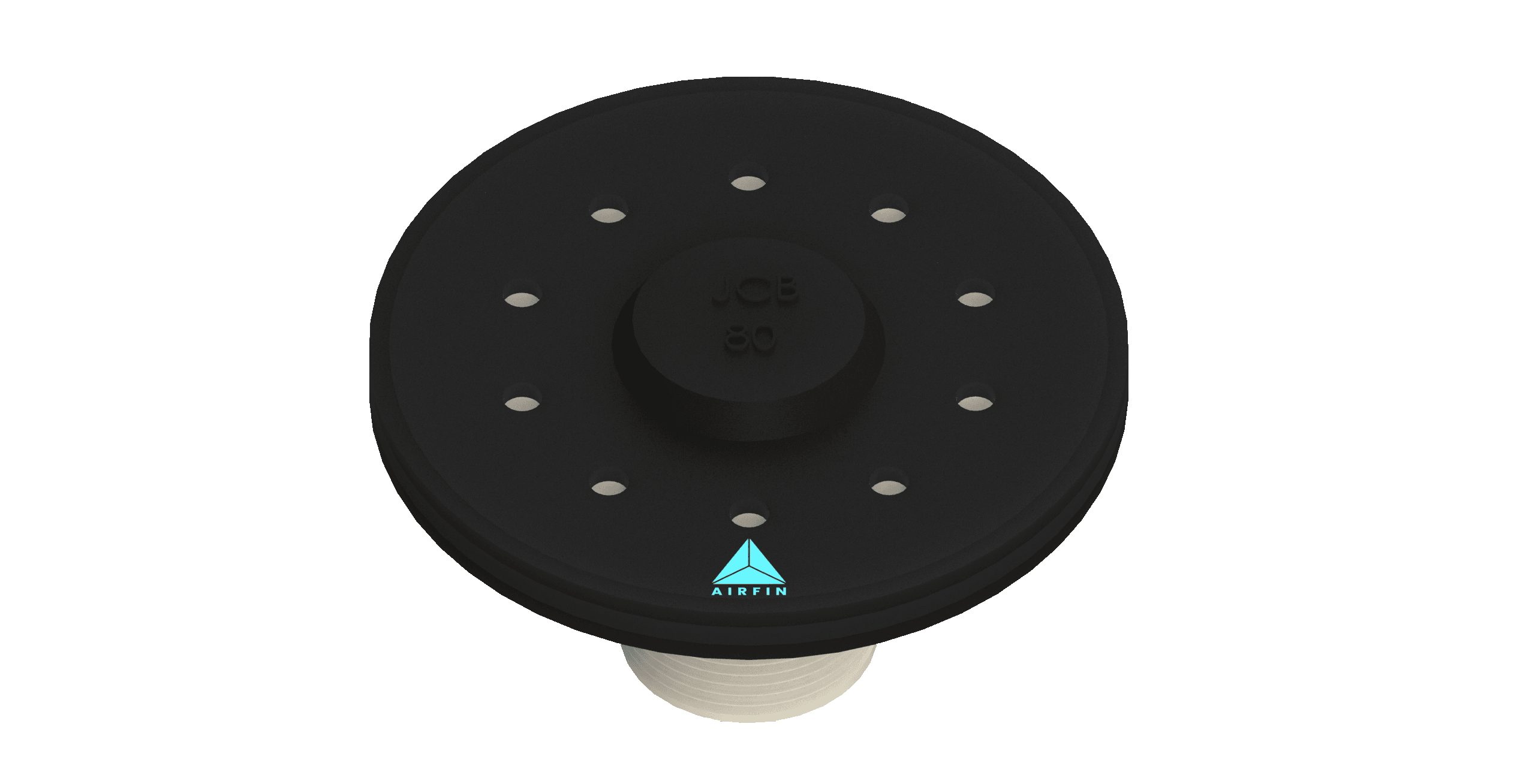
Every aeration datasheet leads with oxygen transfer efficiency, and for good reason: aeration is the largest single electrical load in most treatment plants. But a large share of the diffusers running in any working plant are not transferring oxygen for a biological process at all. They are keeping solids in suspension, scouring a membrane, blending a dosed chemical, or turning over an equalisation basin. Specifying a coarse bubble diffuser against an SOTE figure, or worse, specifying a fine pore grid for one of those duties because its SOTE is higher, is how plants end up with blinded membranes in a balancing tank and blowers that cannot hold DO in a digester. The concept underneath all of it is simple: bubble size buys either interfacial area or momentum, and the duty decides which one you are actually paying for.
Bubble Size Buys Area or Momentum, Not Both
Oxygen transfer from a bubble swarm is governed by the volumetric mass transfer coefficient acting on the saturation deficit. The interesting term is the interfacial area per unit liquid volume, which for a dispersion of bubbles of diameter d at gas holdup e is 6e/d. Halve the bubble diameter at constant air flow and you roughly double the interfacial area. Smaller bubbles also rise more slowly, so each one spends longer in the water column and gives up a larger fraction of its oxygen before it breaks the surface. Those two effects compound, which is why fine pore aeration can deliver the same oxygen as coarse bubble aeration on roughly half the air.
The same physics works against you the moment the duty changes. Mixing is not a mass transfer problem; it is a momentum problem. A rising bubble plume entrains liquid and drives the roll cell that keeps solids in suspension, and that entrainment scales with the buoyant momentum flux the plume carries. Large, fast-rising bubbles are good at it. Fine bubbles, being small, slow and quickly saturated, are not. A fine pore grid that is beautifully efficient at oxygenating an aeration basin will leave solids on the floor of a deep equalisation tank, and it will do so while its pores blind over with the very solids it failed to lift.
The size bands are distinct enough to treat as separate technologies. Fine pore membranes produce bubbles of roughly 1 to 3 mm. Coarse bubble devices operate an order of magnitude higher: AIRFIN JCB disc diffusers at 4 to 5 mm, and the WB 800 tubular diffuser at 5 to 15 mm through paired 4 mm and 12 mm orifices. Nothing about the second group is a degraded version of the first. They are sized, piped and maintained against a different objective.
Alpha, Fouling, and the Gap That Narrows in Service
Alpha is defined in the ASCE clean water testing framework as the ratio of the volumetric mass transfer coefficient in process water to that in clean water. It is a property of the liquor acting on the device: surfactants collect at the gas-liquid interface, suppress surface renewal, and depress transfer. The fouling factor F is a separate quantity describing the decline in performance of a given diffuser with time in service as its pores scale, biofoul and stiffen, and it has historically been carried at a fixed value of 0.75 in design work. Trade literature routinely describes coarse bubble diffusers as high-alpha devices when what it actually means is fouling-resistant. Keep the two apart. Alpha is set largely by the wastewater, F largely by the diffuser and the maintenance regime, and only F is something you can specify your way out of.
The distinction matters because the two effects land differently on the two technologies. A fine pore membrane forms bubbles by flexing thousands of slits open against back pressure. As the elastomer stiffens with age and the slits partially occlude with carbonate scale and biofilm, bubble size creeps upward, dynamic wet pressure rises, and the diffuser drifts toward coarse bubble behaviour while still demanding the blower head of a fine pore system. A coarse bubble device forms bubbles at drilled or moulded orifices measured in millimetres, and an orifice that size does not meaningfully change because a film has grown on it. That is the whole of the durability argument, and it is a geometric argument rather than a materials one.
Design codes acknowledge this explicitly. Texas Commission on Environmental Quality design criteria for domestic wastewater systems require that wastewater oxygen transfer efficiency be taken as the clean water value multiplied by 0.65 for a coarse bubble diffuser and by 0.45 for a fine bubble diffuser, and treat any claim above 18 percent clean water transfer efficiency for coarse bubble, or 26 percent for fine bubble, as innovative technology requiring additional approval. Read those two derating factors together: at code level, the coarse device is credited with retaining substantially more of its rating once real wastewater is in the tank. That does not make coarse bubble aeration the efficient choice for a biological basin, because the clean water starting points are far apart. It does mean that comparisons made on catalogue transfer efficiency alone overstate the practical difference.
The clean-water gap between fine pore and coarse bubble aeration is the widest it will ever be on the day the tank is filled. Everything that happens afterwards closes it.
The Three Duties a Coarse Bubble Diffuser Is Actually For
Almost every coarse bubble installation falls into one of three categories, and each is sized on a different governing number.
Mixing and equalisation
Mixing air is sized on volume, not on oxygen. The TCEQ criteria illustrate the logic neatly by using different units for the two technologies: at least 20 standard cubic feet per minute per 1,000 cubic feet of tank volume for a coarse bubble diffuser, against at least 0.12 scfm per square foot of floor for a fine bubble system. The coarse bubble rule is volumetric because a coarse plume mixes by driving a full-depth roll cell. The fine bubble rule is areal because a fine pore grid mixes, to the extent that it mixes at all, as a distributed blanket lifting the column directly above it. Substitute one rule for the other on a deep tank and the error is large and in the wrong direction.
The practical consequence for layout is diffuser density. AIRFIN specifies a minimum of one JCB 100 or JCB 150 disc per square metre of floor for mixing duty, and two JCB 80 discs per square metre, with a standard airflow of 1 to 10 m3/hr per diffuser and a range extending to 25 m3/hr. Those two figures, units per square metre and airflow per unit, are what determine whether a tank mixes. The transfer efficiency of the individual diffuser does not enter the calculation at all.
Air scouring and membrane bioreactors
Membrane scour is the clearest case of aeration bought purely for momentum. In an immersed MBR, coarse bubble aerators sit beneath the membrane units and the design intent is to maximise the shear generated as large bubbles pass across the membrane surfaces. The duty is normalised as specific aeration demand per unit membrane area, SADm, in Nm3 per m2 per hour; the Kubota flat sheet system, for example, carries a standard coarse bubble scour rate of 0.75 Nm3/h per m2 of membrane. Membrane scour air accounts for roughly one third of total energy consumption in a full scale MBR, which is precisely why the industry has spent two decades driving SADm down rather than improving the transfer efficiency of the scour aerator. Nobody cares what the scour air transfers. They care what it shears.
Scour duty also dictates construction. The AIRFIN WB 800 tubular diffuser is offered in uPVC with ABS at 0.6 kg and in SS 304 or 316 at 1.6 kg, both rated 0 to 40 m3/hr with a standard design flow of 20 m3/hr per unit on a 3/4 inch BSP connection. The choice between the two variants is a materials question driven by temperature and chemistry, not a performance question; the air side behaviour is identical.
Aerobic digestion and high-solids liquors
The third duty is aeration in liquors where fine pore diffusers either cannot survive or cannot perform: aerobic digesters, sludge holding tanks, and industrial effluents heavy in grit, oil or surfactants. Two things happen as solids concentration rises. Apparent viscosity increases and coalescence behaviour changes, which depresses alpha for every device in the tank. At the same time the fouling and abrasion load on a fine pore membrane rises sharply, so F falls faster. The device with the higher starting efficiency loses more of it, and loses it while imposing a cleaning regime that usually requires the tank to be taken out of service and drained. A non-clog coarse bubble disc rated across 1 to 25 m3/hr, whose service life is governed by an orifice rather than by an elastomer, is frequently the lower lifecycle cost answer even where oxygen rather than mixing is the stated objective.
Failure Modes Worth Designing Against
- Specifying a mixing duty against transfer efficiency. The number has no bearing on whether solids stay in suspension, and chasing it puts fine pore grids into tanks that will destroy them.
- Ignoring minimum airflow per diffuser. Every diffuser has a lower stable limit. Turn a grid below it and distribution across the header goes unstable, the shallowest units take the flow, and liquid can enter the lower legs.
- Applying a floor-area mixing rule to a deep tank. Coarse bubble mixing is volumetric; a tank of twice the depth needs roughly twice the air for the same plan area.
- Treating base materials as interchangeable. PP with steel, nylon, ABS, uPVC with ABS and SS 304 or 316 are selected against temperature, oxidants and solvents, not against unit price.
- Sizing air piping to design flow. TCEQ criteria require the capacity of the diffuser system including pipework to equal 150 percent of the design air requirement, together with a documented hydraulic analysis of headloss from blower to diffuser.
- Forgetting the upstream conditions the code assumes. Minimum diffuser submergence under those same criteria is 7 feet, and plants with grit concentrations that would interfere with diffuser operation must provide grit removal ahead of aeration or multiple basins so one can be taken out of service.
What to Settle Before You Open a Datasheet
Selection becomes straightforward once the duty is stated honestly. In order of precedence:
- What is the air for? Oxygen, momentum, or both. If both, establish which one governs at minimum load, because that is the case that sets the blower.
- Tank geometry and submergence. Depth sets header pressure and the volumetric mixing demand; plan area sets diffuser count.
- Solids, grit and oil loading, and whether the tank can realistically be drained for maintenance at all.
- Chemistry and temperature, which fix the material of construction before any performance comparison becomes meaningful.
- Required turndown. The ratio between maximum and minimum stable airflow per diffuser is a hard constraint on how far a grid can follow load.
- Connection and retrofit constraints: thread form, header spacing, and whether the existing grid geometry is being retained.
Against that list, a coarse bubble range reads as a set of answers rather than a set of features. The AIRFIN JCB discs cover 3 inch, 4 inch and 6 inch sizes with top, bottom and peripheral air discharge respectively, in PP with steel, nylon and ABS, on 3/4 inch BSP, 3/4 inch NPT and 1 inch BSP connections, all non-clog and all producing 4 to 5 mm bubbles across 1 to 25 m3/hr. The WB 800 tubular covers the higher unit airflows to 40 m3/hr with 26 or 44 perforations across dual 4 mm and 12 mm orifices, in uPVC with ABS or in SS 304 or 316. The question being answered is which duty and which liquor, not which product is better.
Most Plants Need Both, and Should Buy Them as One Air System
At plant level this is a false choice. A well-designed works runs fine pore diffusers in the aeration basin, where oxygen is the product and the liquor is comparatively benign, and coarse bubble diffusers in the equalisation tank, the digester, the sludge holding tank, the scrubber and beneath the membranes, where momentum is the product and the liquor is not. What matters is that the two are sized as parts of one air system. Blower selection, header sizing and turndown strategy have to satisfy the sum of an oxygen demand that varies diurnally and a mixing demand that has a hard floor, and it is usually the hard floor that sets the minimum blower. Designing the two grids in isolation is how plants finish commissioning with machines that cannot turn down far enough to run overnight without blowing off air.
The judgement to carry away is narrow and useful. Before comparing any two diffusers, decide whether the air is being bought for oxygen or for momentum. If it is oxygen, transfer efficiency is the right axis, and the derated in-service value is the number that matters rather than the clean water headline. If it is momentum, transfer efficiency is close to irrelevant, and the right axes are airflow per diffuser, diffusers per square metre, stable turndown, and whether the device will still be passing air unattended in five years. Most of the expensive aeration mistakes in this industry come from applying the first set of criteria to the second kind of duty.
AIRFIN manufactures both coarse bubble disc and tubular diffusers in-house alongside its fine pore range, and can advise on duty-based selection or on retrofitting an existing grid.