
Sludge Dewaterability: Why the Machine Isn't the Variable
Why sludge dewaterability is decided upstream of the press, and what to measure before specifying a dewatering machine.
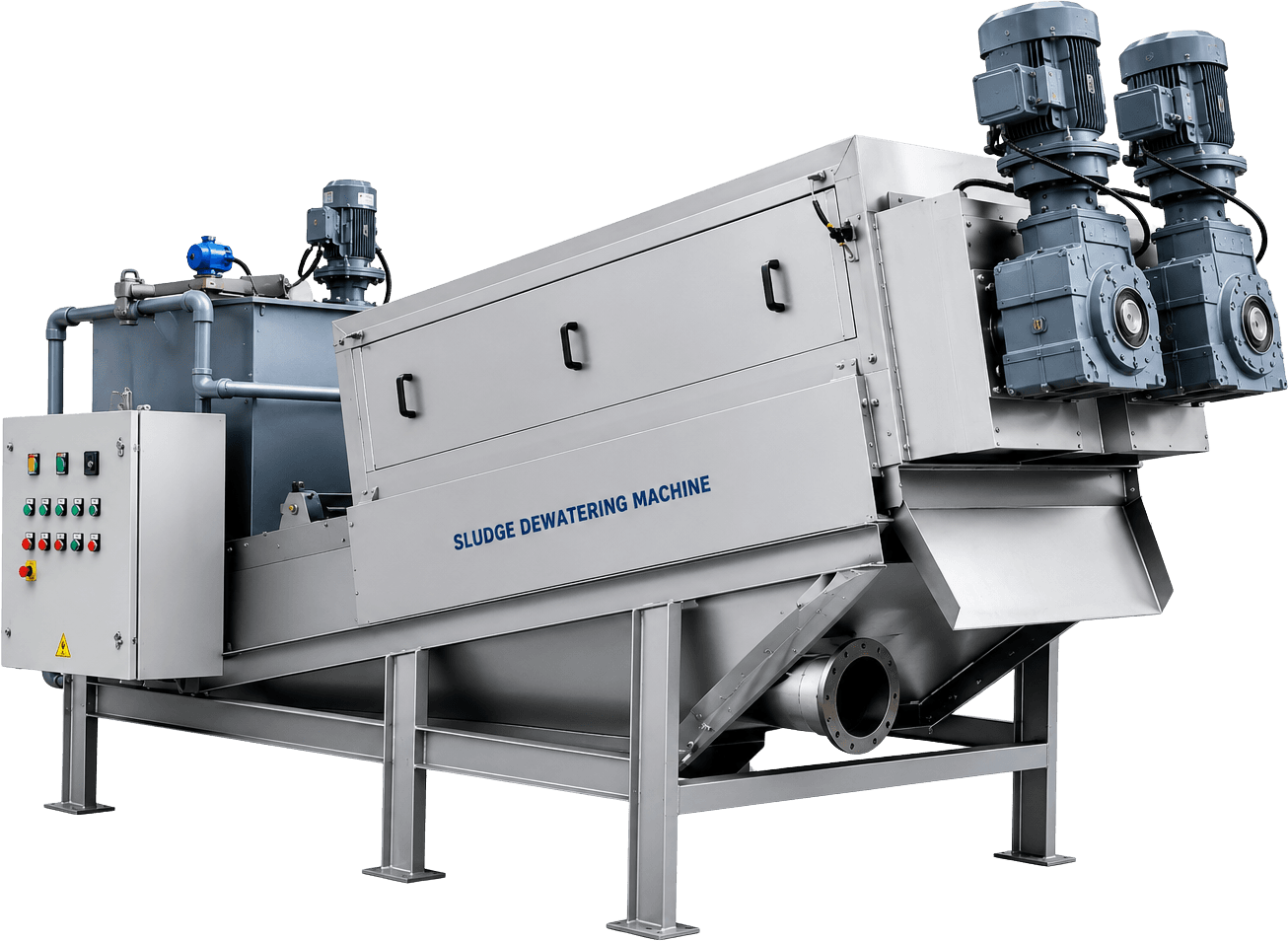
Sludge dewaterability is a property of the sludge, not of the machine bought to dewater it. This is the single most expensive misconception in solids handling. When cake comes off wetter than the guarantee, the instinct is to blame the press — to raise belt tension, increase bowl differential, add a stage, or start a procurement cycle for a bigger unit. Very often the machine is fine and the sludge has changed. Because hauling and disposal cost scales directly with cake mass, a few percentage points of moisture translate into a permanent, recurring operating expense that no amount of mechanical adjustment will recover. Understanding what actually sets dewaterability, and how to measure it before specifying equipment, is the difference between a dewatering system that meets its business case and one that quietly overspends for twenty-five years.
Where the Water Actually Is
A dewatering machine applies a pressure or a centrifugal field and gives water a path out. That works well for water that is free to move and progressively worse for water that is not. Biological sludge holds its water in several distinct states: bulk water between flocs that drains under gravity, interstitial water trapped inside the floc structure, water held at particle surfaces, and water chemically or physically bound within the biomass itself. Only the first two categories respond meaningfully to mechanical force.
The mechanism that governs the difficult fractions is extracellular polymeric substance — the protein and polysaccharide gel that microorganisms secrete and that holds an activated sludge floc together in the first place. Research on the role of EPS in dewatering describes a cross-linked gel network that traps interstitial water and adsorbs interfacially bound water, encapsulating sludge particles and obstructing the flow path between inner and outer water. The same EPS generates electrostatic repulsion between particles, which is precisely what keeps the colloidal fraction stable in suspension rather than consolidating into a filterable cake. Studies that deliberately degrade EPS — by oxidation or other pretreatment — report larger flocs and the conversion of bound water into free water, which is the clearest available evidence that the gel structure, not the applied pressure, is the limiting term.
This is why mechanical dewatering across all conventional device types lands in a fairly narrow band of roughly 20 to 35 percent cake solids. The machines are not the bottleneck. Past a certain point, additional force compacts the floc network without liberating water from it, and the marginal return on pressure collapses.
Dewaterability Is a Measurable Property, Not an Opinion
Because dewaterability is a sludge characteristic, it can be measured independently of any machine — and it should be, routinely. Two bench tests dominate practice. Specific resistance to filtration (SRF) is the more rigorous, and the more expensive and time-consuming to run. Capillary suction time (CST) is the empirical workhorse: it measures how fast water wicks out of a conditioned sample into filter paper, and it correlates well enough with SRF that most plants use it as the day-to-day indicator.
The useful thresholds are simple. CST values below about 20 seconds indicate conditioning good enough for economical dewatering. The reciprocal, 1/CST, behaves as a dewatering rate, which makes it the right variable to plot when you are optimising. And the polymer dose that produces the minimum CST is the optimum dose — not the dose that makes the jar look best, and not the dose the vendor set at commissioning three years ago.
Reading a Dose-Response Curve
A dose-response test — bench jar tests weekly, full-scale dose response monthly — is the only way to separate the four performance variables that actually matter and that trade against each other:
- Cake dryness — percent total solids in the discharged cake, which sets hauling and disposal cost.
- Polymer dose — pounds of active polymer per dry ton of solids processed, which sets chemical cost.
- Capture rate — the fraction of feed solids that report to the cake rather than back to the plant in the filtrate or centrate.
- Throughput — solids processed per hour, which sets how many units and how many operating shifts you need.
Any one of these can be improved by sacrificing the others. Cake dryness can almost always be bought with more polymer, lower throughput, or worse capture. A guarantee quoted on cake solids alone, without a simultaneous polymer and capture figure, is not a guarantee — it is a single point on a surface. Solids returned in filtrate are not free either: they recycle to the head of the works and reappear as load.
The press does not create dewaterability. It converts whatever dewaterability the sludge already has into cake, at a price paid in polymer, energy, and capture.
What Changes Upstream Shows Up at the Press
When a plant reports that cake has gradually got wetter with no change to the dewatering equipment, the cause is almost always upstream. Floc structure and content are set by the primaries, the waste activated sludge, digestion, and thickening — every process that touches the solids before they reach the press. The parameter that correlates most strongly with poor dewatering is colloidal biopolymer content, which in turn tracks soluble COD. Measuring sCOD in sludge routinely is a cheap early warning that the feed is drifting, and it converts an argument about equipment into a diagnosis about process.
Biological phosphorus removal is the clearest documented example of an upstream decision that is paid for downstream. Plants that add Bio-P have reported cake solids falling by roughly four percentage points after anaerobic digestion, an effect attributed mainly to released orthophosphate. That is a large penalty, and it is invisible in the dewatering equipment specification because it originates in the liquid train. It is also partially recoverable: pilot work on phosphate precipitation and struvite recovery from digested sludge has shown improved dewatering performance, which reinforces that the mechanism is chemical rather than mechanical.
The practical consequence for anyone specifying equipment is uncomfortable but important: if the plant is scheduled for a nutrient removal upgrade, thermal hydrolysis, or a change in digestion, the sludge that the new press will see is not the sludge that was sampled during pilot testing. Performance criteria should be set against the future feed, with an explicit allowance for the shift.
Conditioning Is Chemistry and Hydraulics, Not Just Dose
Polymer conditioning is where most recoverable performance sits, and where most plants operate on habit. Selecting a conditioner involves at least four variables beyond dose: form (dry, liquid, or emulsion), charge density in milliequivalents per gram, molecular weight, and chain architecture — linear, branched, cross-linked, or structured. The last of these is routinely ignored and matters more than expected, because it determines how the floc survives the shear the machine imposes on it.
Work reported by Dentel and co-workers, cited in dewatering optimisation practice, makes the point sharply: conditioning with a linear polymer produced progressively worse dewatering as mixing shear increased from 100 to 330 rpm, while a cross-linked polymer improved dewatering under the same high-shear conditions — at the cost of a higher dose. This is the physical explanation for a common and confusing field observation: a polymer that performs beautifully in a quiescent jar test underperforms on a high-shear centrifuge, and the conclusion drawn is usually that the centrifuge is at fault. The polymer architecture was simply mismatched to the shear regime. The corollary is that the point at which polymer is injected, and the mixing energy and time it sees before the machine, are design parameters, not plumbing details.
Polymer Is Not a Commodity
There is a further trap in procurement. Three batches of nominally the same polymer product, analysed side by side, returned charge densities of 4.65, 3.24 and 4.41 meq/g and single-point intrinsic viscosities — a proxy for molecular weight — of 10.4, 12.0 and 8.0 dl/g, with ash contents from 4.0 to 11.6 percent. Those are not trivial variations; they are enough to move cake solids by themselves. Most polymer tender documents specify price per kilogram and contain no quality control specification at all, which means the plant has no contractual basis to object when performance drifts. If polymer is one of the largest lines in the dewatering operating budget — and at large plants it is — then charge, molecular weight and purity belong in the bid documents with test methods attached.
What the Machine Actually Contributes
None of this means equipment selection is irrelevant. It means the machine should be chosen for how it fits the plant, the operators, and the whole-life cost, because the spread in cake dryness between technologies is smaller than most selection studies assume.
A dewatering technology selection study for the Salt Lake City Water Reclamation Facility piloted four machines on the same anaerobically digested feed over consecutive weeks. The averaged results are instructive. A centrifuge produced 25 percent cake at 21 lb of polymer per dry ton with 99.7 percent solids capture. A horizontal screw press produced 23 percent cake at 26 lb/dt and 99.5 percent capture; an inclined screw press produced 23 percent cake at 24 lb/dt and 96 percent capture; a belt press produced 21 percent cake at 11 lb/dt and 99 percent capture. Across four fundamentally different machines on one sludge, cake solids spanned four percentage points — while polymer demand varied by more than a factor of two, and capture on one unit ranged from 80.6 to 99.9 percent across its test week.
Read that table properly and the selection question changes shape. The belt press was the wettest and by far the cheapest to condition. The centrifuge was the driest and, in the same study, the option with the smallest footprint and lowest total lifecycle cost, with screw presses about 13 percent and belt presses about 23 percent higher on a twenty-five year basis at that site. Yet the facility selected screw presses, because operators ranked them highest on reliability, maintainability and safety, and because the study weighed documented risks of higher cake odour and pathogen regrowth associated with centrifuge cake. The economically optimal machine and the correctly selected machine were not the same machine.
Useful selection criteria, in the order they usually decide the outcome:
- Feed characteristics you have actually measured — sCOD or colloidal biopolymer, CST after conditioning, and the effect of any planned liquid-train change — rather than a nameplate sludge type.
- The four-way trade among cake solids, polymer dose, capture rate and throughput, quoted together as a single operating point, not as separate best cases.
- Shear tolerance of the conditioning chemistry available to you, since a high-shear machine constrains polymer architecture and therefore polymer cost.
- Wash water demand and its return load, which is significant for belt presses and low for centrifuges and screw presses.
- Enclosure, odour and cake handling, which drive odour control capital and, at Class A sites, pathogen regrowth risk.
- Whether your operators can maintain it — specialist rebuild intervals and parts lead times on high-speed equipment are a genuine availability risk, and the people who run the plant are usually right about this.
- Whole-life cost including hauling, which in the Salt Lake City analysis was the largest single component of annual operating cost, ahead of polymer and labour.
Specify Against a Sludge You Have Measured
The discipline that follows from all of this is straightforward, and it is mostly about sequence. Characterise the sludge before shortlisting machines: run CST on conditioned samples and establish a dose-response curve, so you know the dewaterability you are starting from and the polymer dose that reaches it. Where the feed will change — a nutrient removal upgrade, new digestion, a different thickening route — state the future condition in the specification and require performance against it. Insist that vendor guarantees name cake solids, polymer dose and capture rate simultaneously, at a defined throughput. Where the decision is close, pilot side by side on the real feed, as the machine ranking is frequently decided by operability and odour rather than by percentage points of dryness. And once running, treat conditioning as a controlled process: dose-response testing at a regular cadence, sCOD monitoring on the feed, and polymer quality specifications with test methods written into the supply contract.
AIRFIN manufactures sludge dewatering machines in-house as part of its wastewater treatment equipment range, alongside the clarifiers, DAF systems and biological treatment media that determine what arrives at the press, and its process engineering and plant audit teams work on exactly this kind of feed characterisation and retrofit assessment — so if you are evaluating a dewatering upgrade or diagnosing a cake that has quietly got wetter, it is worth a conversation before the procurement starts.
The judgement to carry away is this: a dewatering machine converts an existing property of your sludge into cake, and it can only work with what the upstream process gives it. Money spent measuring dewaterability, controlling the conditions that degrade it, and specifying conditioning chemistry properly will nearly always return more than money spent on a larger press. Measure first, then buy.