
Why Submersible Sewage Pump Clogging Isn't About Size
Why the spherical solids rating on a sewage pump datasheet does not predict clogging, and what actually governs rag passage in service.
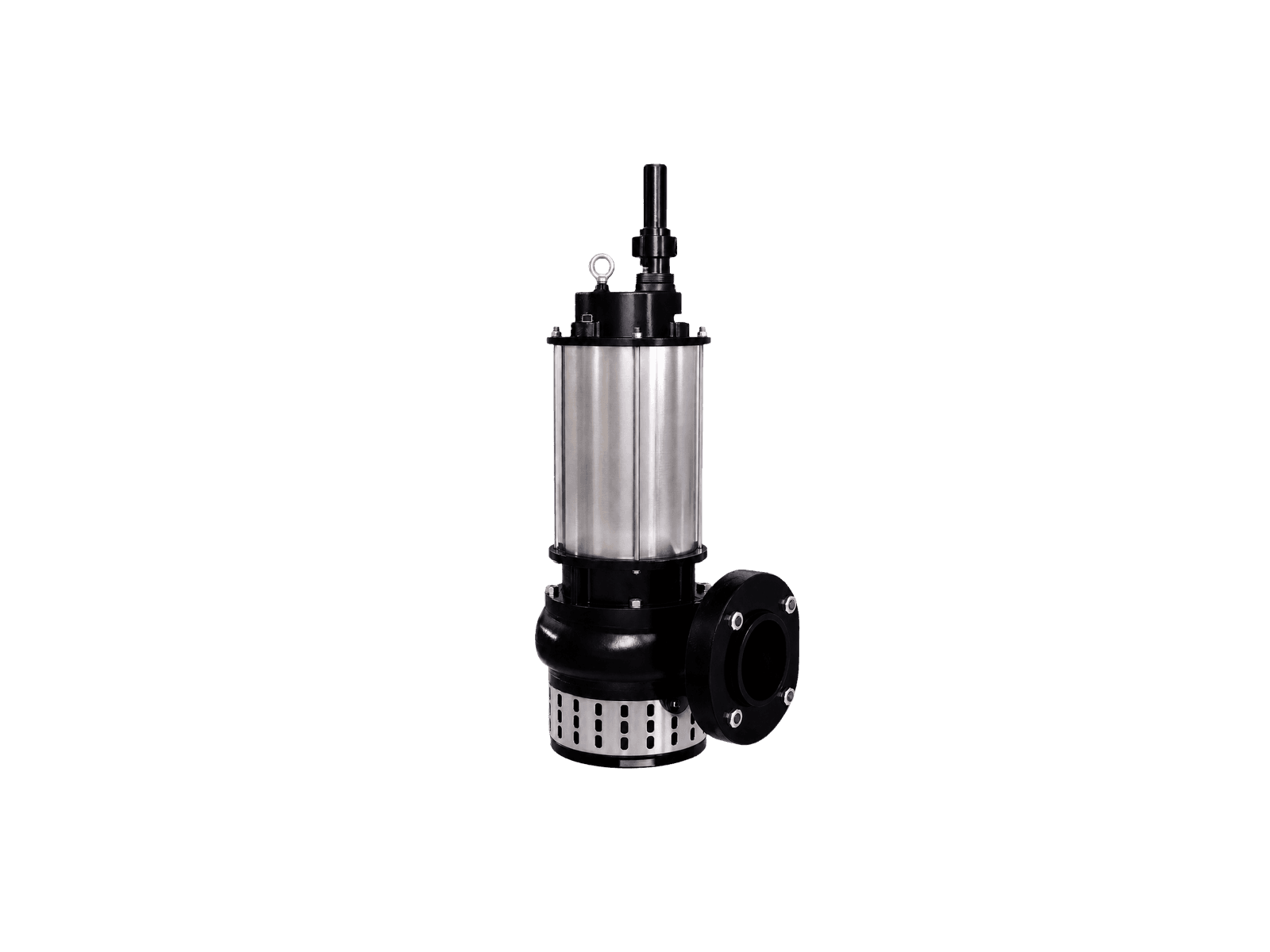
Every submersible sewage pump datasheet carries a solids passage figure — 50 mm, 80 mm, 100 mm — and almost every specification written around it treats that number as a clog-resistance rating. It is not. It is a geometric statement about the narrowest cross-section in the flow path, verified by rolling a sphere through it. Real sewage does not arrive as spheres. It arrives as hydroentangled nonwoven fibre, textile rag, hair, and plastic film, and those materials fail a pump by a mechanism the sphere test cannot see: they hang on a leading edge and accumulate. Specifying submersible sewage pump clogging resistance on the strength of a solids passage number is how a station ends up with two pumps that both meet the spec and both need de-ragging every fortnight.
What the Solids Passage Rating Actually Measures
The sphere test is exactly what it sounds like. A solid ball of stated diameter is passed through the suction, the impeller passage, and the discharge without jamming. It bounds the smallest throat in the hydraulic path — usually between the impeller vane and the shroud or wear plate — and nothing more.
Regulators use it because it is unambiguous and auditable. Ontario's Design Guidelines for Sewage Works require that, except where grinder pumps are used, pumps handling raw sewage be capable of passing spheres of at least 80 mm (3 in) in diameter, with suction and discharge openings at least 100 mm (4 in). That is a floor on geometry, and a sensible one: a pump that cannot pass an 80 mm sphere will certainly not survive a municipal wet well. But clearing the floor tells you nothing about what happens when the object is compliant, fibrous, and 400 mm long in one dimension and 0.5 mm in another.
It is worth noting that the trend in hydraulic design works against the rating. As manufacturers add vanes to recover efficiency, the passage between vanes narrows; several higher-efficiency multi-vane designs no longer pass the 3 in solid that older two-vane hydraulics did. If the sphere rating matters for your application, it needs to be confirmed against the specific impeller supplied, not the series.
Why Fibrous Solids Behave Nothing Like Spheres
The material is engineered not to fall apart
A wet wipe is a nonwoven fabric, typically wetlaid and hydroentangled from wood pulp blended with regenerated cellulose such as lyocell or viscose. The regenerated fibres form a load-carrying skeleton that supplies wet tensile strength; the pulp supplies absorbency. That is a deliberate design compromise, and it means the sheet is built to hold together when saturated — which is precisely the state it is in when it reaches your pump.
Laboratory work on dispersibility makes the point sharply. Wetlaid hydroentangled wipes that disperse acceptably when fresh lose that property after storage in wet condition, so the material arriving at a lift station after hours of sewer transit is generally less dispersible, not more. Wipes containing regenerated cellulose require more force to disintegrate than those made from unmodified cellulose. The dominant break-up mechanism is fibre slippage, governed by wet fibre-to-fibre cohesion; longer fibres and fibrillation-resistant fibres both resist it. Nothing about the residence time or shear regime in a sewer is sufficient to overcome that.
Compounding this, water-conservation fixtures have reduced the dilution volume carried with each solids load. The waste stream reaching a modern lift station is denser and more abrasive than the one the hydraulics of thirty years ago were sized against.
Capture happens at the leading edge, not the throat
A sphere either fits the passage or it does not — a binary geometric outcome. A rag is a flexible, extensible body that drapes. Visualisation work using a transparent double-blade pump and high-speed imaging shows that rag passage is probabilistic rather than deterministic: passage time varies strongly with rag material, size, quantity, and impeller rotational speed, with the maximum observed passage time exceeding the shortest by more than one hundred percent for the same nominal object. Rags that linger are rags that meet another rag. Once two fibres bridge a vane leading edge, the accumulation is self-reinforcing — each subsequent piece has a larger obstruction to catch on.
This is why clogging is a threshold phenomenon rather than a gradual one. Head and flow look normal, then over a handful of cycles the pump falls off its curve entirely. Motor current usually rises before flow falls, because the trapped mass increases hydraulic loading on the vane before it fully blocks the passage.
Impeller Geometry Is the Real Variable
If the failure mode is leading-edge capture, then the number, shape and setting of the vanes — not the sphere diameter — is what you are actually specifying. The practical families, and what each buys and costs:
- Single-vane closed or semi-open: one continuous passage and one leading edge to snag on. Best conventional choice for stringy and fibrous solids. Inherently unbalanced hydraulically, so bearing and seal loading is higher and the pump is less forgiving of running far off its best efficiency point.
- Two-vane: better hydraulic balance and slightly higher efficiency than single-vane, at the cost of a second leading edge and a narrower passage. A reasonable default for domestic sewage with moderate rag loading.
- Multi-vane semi-open: the efficiency-driven option, and the one most likely to fail its own sphere rating. Suited to screened or largely fibre-free effluent, not raw municipal collection.
- Vortex (recessed) impeller: the impeller sits back from the volute and induces a rotating column so that most of the solids pass without contacting the vanes at all. This is the strongest defence against wipes and textile, and it is bought with efficiency — vortex hydraulics typically run in the region of a quarter to a third less efficient than an equivalent non-clog design, which means a larger motor, higher capital cost, and higher energy through the life of the station.
- Cutter and chopper arrangements: a shearing element at the inlet reduces solids before they reach the impeller. Effective against fibrous and stringy media, but it adds a wearing part, draws additional torque, and shifts the failure mode from blockage to cutter-edge dulling — which is a maintenance regime, not an absence of one.
Clog resistance is not a specification you buy with a larger sphere rating. It is a trade you make against hydraulic efficiency, and it should be made deliberately.
The honest framing for a client is that clog resistance and efficiency sit on the same axis. Opening a passage to let fibre through costs head and costs power. The right position on that axis depends on what the catchment actually delivers and what an unplanned de-ragging call-out costs — and in stations serving public buildings, hospitality, or hospitals, where the flushed inventory is beyond anyone's control, that call-out cost dominates. Published utility experience puts clog-clearing costs at lift stations in the six figures over a period of a couple of years for a single problem station.
The Pump Is Only Half the System
A clog-resistant impeller in a badly shaped sump will still clog, because the sump decides what arrives at the impeller eye and in what state. Three things matter.
First, dwell. Solids that sit in a wet well stratify: grit settles, grease and fibrous material float and mat. A pump that draws down into a settled grit bed or through a surface rag mat is being fed a concentrated slug rather than a dilute stream. Steep wet well sides and a benched, self-scouring floor profile reduce the area available for accumulation, and setting the lag-pump start elevation so that solids deposition does not occur — Ontario's guidance places high sewage level approximately 300 mm below the inlet sewer invert where basement flooding or deposition would otherwise be a risk — keeps the working volume in motion.
Second, discharge velocity. A force main below its self-scouring velocity deposits solids that later re-mobilise as a slug. Ontario requires that firm station capacity, with the largest unit out of service, maintain a minimum velocity of 0.6 m/s (2 ft/s) in the force main. Other jurisdictions state the same lower bound alongside an upper limit — Virginia's sewage pump station regulations require a minimum self-scouring velocity of 2 ft/s at pumping capacity and advise against exceeding 8 ft/s without suitable construction methods. Sizing a pump for a duty point that leaves the main below 0.6 m/s at low flow is a design decision to accumulate solids.
Third, what you allow into the well at all. Where the catchment includes combined sewerage or known high-rag sources, a bar rack ahead of the pumps is the cheapest clog control available, provided the design includes access, a hoist, and a screenings handling route. Grit removal, desludging valves and adequate wet well turbulence to keep grit in suspension belong in the same conversation.
Speed Control Cuts Both Ways
Variable speed is now close to default on sewage pumping, and it is genuinely valuable for matching diurnal flow and reducing start frequency. But the clog-resistance implications are usually left out of the business case.
A conventional non-clog pump's ability to pass large solids diminishes as speed is reduced. Two effects combine: the through-passage velocities that carry a rag past the vane fall with speed, and the reduced discharge velocity can drop the force main below its scouring threshold. A station that runs most of its hours at 60 or 70 percent speed is operating in a regime the sphere rating never described. Drive manufacturers have responded with de-ragging routines that ramp the pump or briefly reverse it to shed accumulated material, and these work — but they are a recovery mechanism, not a design allowance, and reverse operation imposes loads on check valves, couplings and the discharge arrangement that not every installation is built for. If the operating philosophy relies on de-ragging cycles, that needs to be in the specification, along with the mechanical consequences.
Specifying for Clog Resistance in Practice
A defensible specification treats the sphere rating as a mandatory minimum and then asks the questions that actually predict service behaviour:
- What is the rag and fibre character of the catchment — domestic, institutional, public-facing, or industrial? Public and institutional catchments justify vortex or cutter hydraulics regardless of what the sphere rating says.
- Confirm the sphere rating against the exact impeller and trim being supplied, not the pump series. Vane count and trim change it.
- Check the duty point against the whole operating envelope, not just peak. What is the force main velocity at minimum speed and at minimum flow, and is it above 0.6 m/s?
- Does the discharge size meet the applicable minimum — 100 mm suction and discharge for raw sewage under Ontario's guidance — or has it been reduced to make a head calculation work?
- Has the wet well geometry been reviewed for dwell, benching, and level setpoints, or has it been inherited from a previous, lower-flow duty?
- What is the intended response to a clog — an operator visit, a drive de-ragging routine, or a cutter that prevents it upstream? Price the lifecycle of that answer, not just the pump.
- Are the shaft seal and bearing arrangement rated for the off-BEP and unbalanced running that a single-vane or partially fouled impeller imposes?
On the equipment side, this is where the configuration options on a submersible range matter more than the headline curve. AIRFIN's WSP Series submersible non-clog sewage pumps are built across 50 mm, 80 mm and 100 mm delivery sizes from 1 HP to 20 HP, covering up to 3800 LPM and 50 m shut-off head at 2900 RPM, with a non-clog impeller as standard and agitator or cutter variants available on request — the agitator to keep settled solids in suspension in the sump, the cutter for fibrous and stringy media that would otherwise wrap a conventional impeller. The wetted materials are specified to the duty rather than fixed: cast iron to IS 210 FG260, SS-304 or SS-316 for casing and impeller, with double mechanical seals in SiC-versus-SiC or TC-versus-TC and IP-68 motor protection with thermal overload for continuous submerged running. Those are the levers that decide whether a pump survives a difficult catchment; the sphere diameter is not.
The Judgement to Carry Away
Treat the solids passage rating as a gate, not a score. It tells you a pump is not disqualified; it does not tell you which of two qualified pumps will still be running unattended in eighteen months. That answer comes from matching impeller geometry to the fibre character of the catchment, keeping velocity above the scouring threshold across the whole operating envelope rather than only at design point, and shaping the wet well so solids never get the chance to consolidate. Where those three are aligned, a modest non-clog pump will outlast an oversized one. Where they are not, no sphere rating on any datasheet will save the station.
AIRFIN manufactures the WSP Series and its cutter and agitator variants in-house, and can advise on impeller selection or a retrofit where an existing station is clogging faster than its rating suggests it should.