
ANSI Process Pump — ACP Series
ANSI B73.1M centrifugal process pumps with investment casting, up to 350 m³/hr flow, 150 m head, and 25.5 Bar for chemical, pharma, and industrial applications.
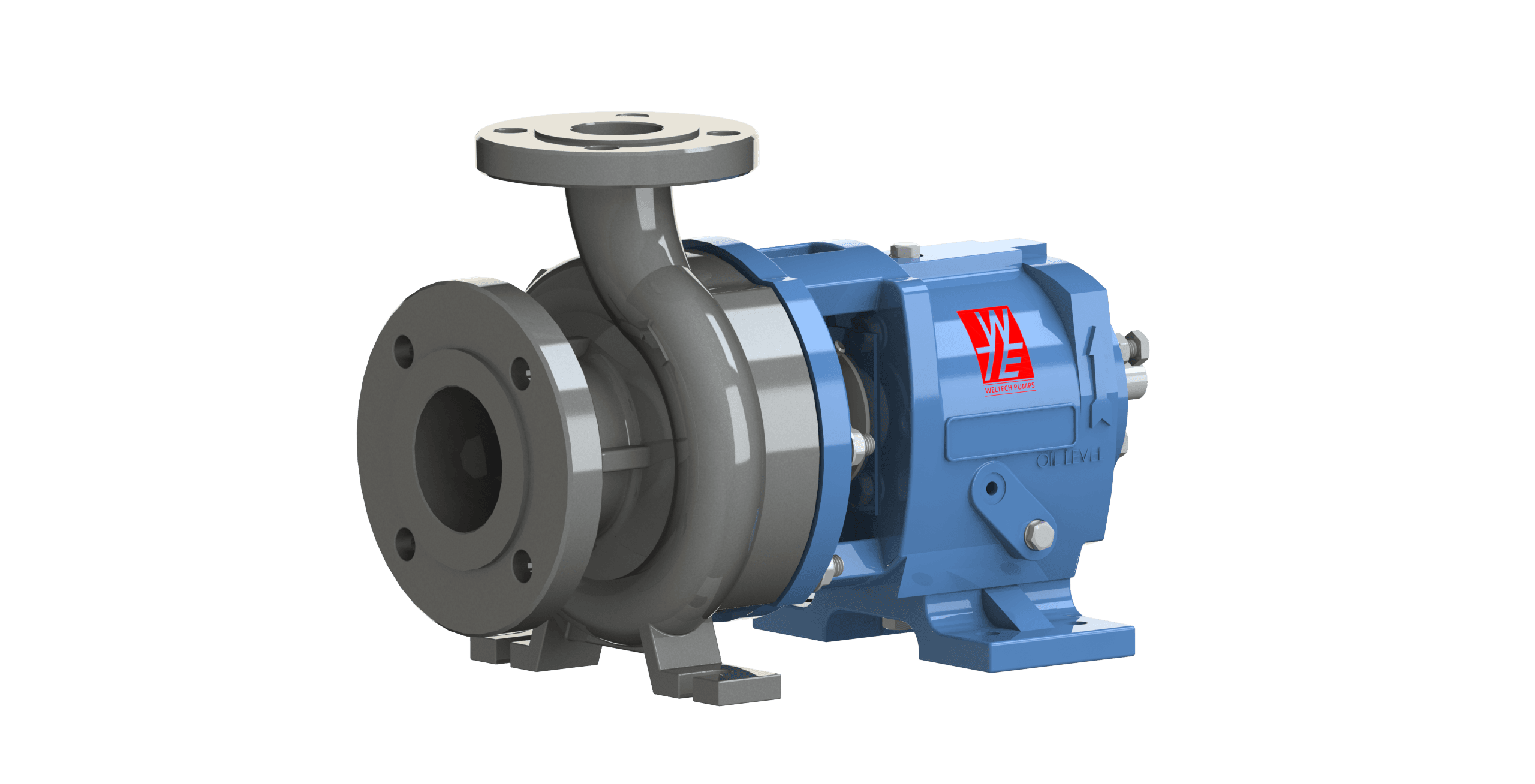
The ACP Series is a range of horizontal centrifugal process pumps designed to the ANSI B73.1M standard. Manufactured through state-of-the-art investment casting, the pumps deliver reliable performance for handling low-viscosity, clean or slightly contaminated liquids across chemical, petrochemical, pharmaceutical, food, textile, and industrial process applications.
With a maximum capacity of 350 m³/hr, head up to 150 m, working pressure of 25.5 Bar, and a temperature range of −210 to 260 °C, the ACP Series covers a wide hydraulic field. The fully open impeller design with back vanes reduces hydraulic loads on the stuffing box and sealing, while the CFM/CFD-optimised suction geometry ensures optimum NPSH with near-zero flow distortion.
The modular back-pull-out design allows quick access to the impeller, stuffing box, and housing without disturbing piping or the motor. Oversized shafts with double-row thrust bearings and IP66 bearing isolators extend bearing life by up to 40%, while shaft deflection is held below 0.05 mm at seal faces.
Available in a wide selection of materials — including industrial, food-grade, pharmaceutical, and petroleum-standard approved metals — with shaft sealing options from gland packing to balanced cartridge double seals, the ACP Series handles most process pump duties with maximum interchangeability between variants.
Key features
- Designed to ANSI B73.1M standards with wider hydraulic field coverage
- Investment casting (IC) process for precision parts and perfect finish
- Fully open impeller with back vanes to reduce hydraulic loads on stuffing box and sealing
- Back-pull out design for easy maintenance without disturbing piping or motor
- Corrosion avoidance design suitable for chemical and pharmaceutical applications
- Sturdy heavy-duty bearing housing with IP66 bearing isolators for near-zero corrosion
- Shaft deflection less than 0.05 mm at seal faces for extended seal and bearing life
- Oversized shaft with double-row thrust bearings — 40% increased bearing life
- CFM/CFD-based suction design for optimum NPSH and near-zero flow distortion
- Available in multiple MOCs — industrial, food grade, pharmaceutical, and petroleum standard metals
- Key-driven impeller eliminates spinoffs due to reverse rotation during start-up
- Wide range of shaft sealing from gland packing to balanced cartridge double seal
Outcomes
- Max capacity of 350 m³/hr and max head of 150 m across the product range
- Max working pressure of 2550 kPa (25.5 Bar) and temperature range of −210 to 260 °C
- Up to 40% increased bearing life from oversized shafts and premium heat-treated bearings
- Modular design with interchangeable parts across variants for minimal downtime
- Reduced risk of leaks, spills, and environmental contamination through advanced sealing
Who it's for
Chemical, petrochemical, pharmaceutical, food & beverage, textile, dye, pulp & paper, pollution control, and general industrial process plants requiring reliable centrifugal pumps for handling low-viscosity, clean or slightly contaminated liquids.
Standards & certifications
- ANSI/ASME B73.1
Performance envelope
Overall operating range across all ACP Series models.
| Specification | Value |
|---|---|
| Capacity | Up to 350 m³/hr |
| Head | Up to 150 m |
| Working pressure | Up to 25.5 Bar (2550 kPa) |
| Temperature | −210 to 260 °C |
| Speed | Up to 3600 RPM |
Technical specifications
Common specifications across the ACP Series range.
| Specification | Value |
|---|---|
| Design standard | ANSI B73.1M |
| Impeller type | Fully open with back vanes, IC cast |
| Shaft sealing | Gland packing / Mechanical seal / Cartridge double seal |
| Bearings | Deep groove ball (sealed/oil) or double-row angular contact |
| Bearing protection | IP66 bearing isolators (BI technology) |
| Shaft deflection at seal face | < 0.05 mm |
| Manufacturing | Investment casting (IC) |
| Suction design | CFM/CFD optimised for NPSH |
| Flanges | ANSI B73.1 standard |
Materials of construction
Available in industrial, food-grade, pharmaceutical, and petroleum-standard metals.
| Specification | Value |
|---|---|
| Casing | SS 304, SS 316, SS 316L, CD4MCu, Alloy 20, Hastelloy C, Monel |
| Impeller | Same as casing — investment cast for precision |
| Shaft | SS 304, SS 316, SS 316L, high-purity steels |
| Bearing housing | Cast iron / Ductile iron — heavy-duty |
Applications
Chemical industries
Transfer of clean to slightly contaminated chemical process liquids.
Petrochemical industries
Duty in refining and petrochemical process lines.
Pharmaceutical industries
Hygienic transfer in pharmaceutical manufacturing with FDA-approved MOC.
Textile & dye industries
Handling of dye liquors and process water in textile plants.
Pulp & paper
Process fluid transfer in pulp and paper manufacturing.
Pollution control
Effluent and chemical transfer in pollution control systems.
Focus areas
- Pumping Solutions