
Sludge Dewatering Machines
Screw press dewatering equipment for efficient solid-liquid separation of sludge using screw extrusion technology — available in SS304 and SS316 construction.
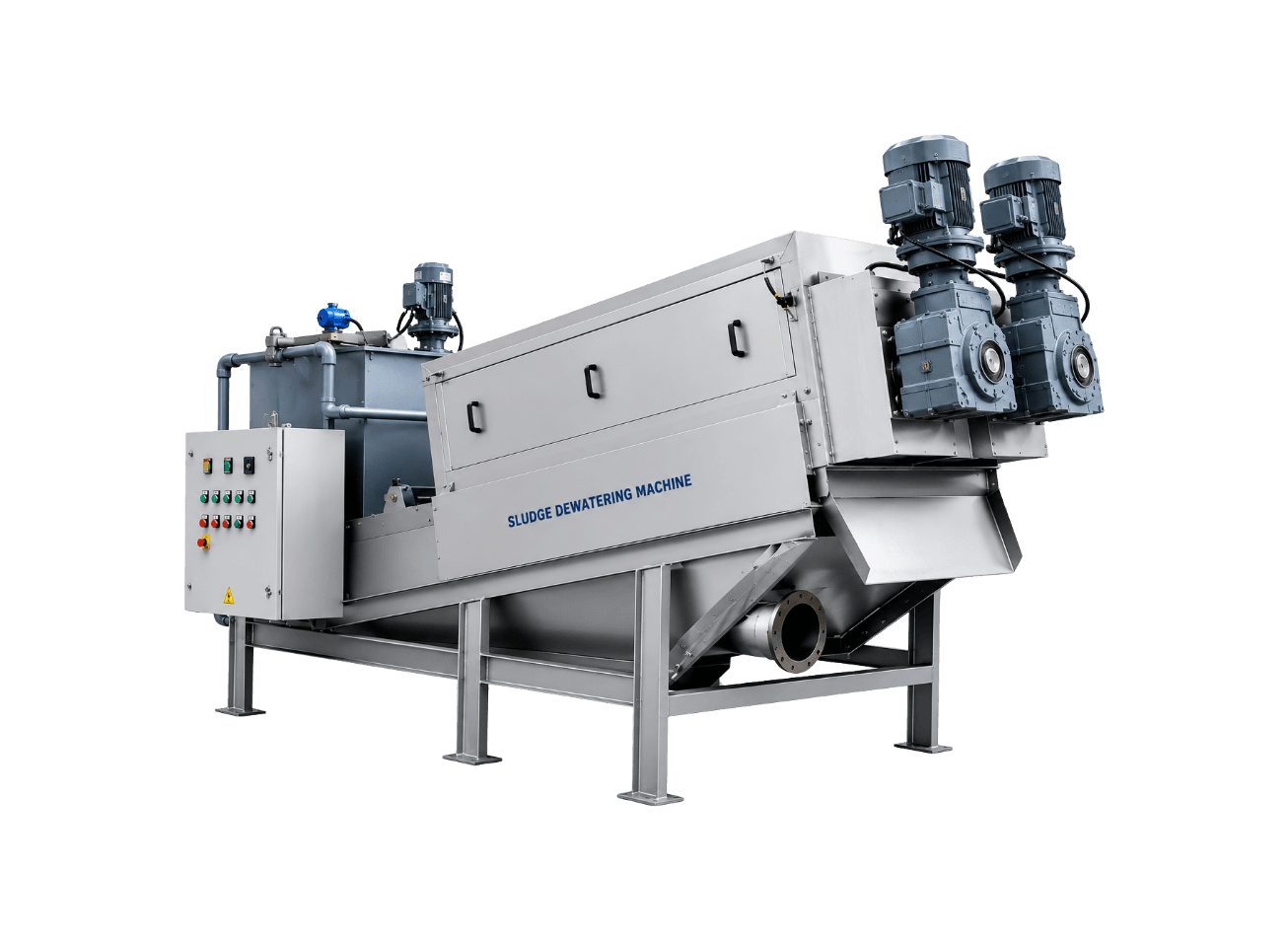
AIRFIN Sludge Dewatering Screw Press is an economical and environment-friendly dewatering equipment based on the screw extrusion principle. The system generates a strong squeezing force through a changing screw pitch, while the tiny gap between floating rings and fixed rings enables effective solid-liquid separation. The floating rings rotate with the screw shaft, providing a self-cleaning action that prevents clogging without the need for external wash water.
The screw press operates at very low speed (2–4 RPM), resulting in minimal power consumption, no noise, and no vibration. This low-speed operation also significantly reduces mechanical wear, extending equipment life and lowering maintenance costs. The enclosed design contains odour and provides a clean working environment for operators.
AIRFIN offers 14 models ranging from 0.25 m³/hr to 20.0 m³/hr, with single or dual screw configurations depending on throughput requirements. Motor power ranges from 0.5 HP for smaller units to 4.0 HP for the largest models. All units are constructed in SS304 or SS316 stainless steel for corrosion resistance and long-term durability.
The sludge dewatering screw press is suitable for a wide range of applications including municipal sewage treatment, industrial effluent treatment, food and beverage processing, pharmaceutical and chemical industries, textile and tanning, and pulp and paper mills. Its compact footprint, fully automatic operation, and minimal maintenance make it an ideal choice for both new installations and retrofit projects.
Key features
- Operates on screw extrusion principle with changing screw pitch for strong squeezing force on sludge
- Tiny gap between floating rings and fixed rings enables effective solid-liquid separation
- Self-cleaning mechanism — floating rings rotate with the screw to prevent clogging without external wash water
- Very low power consumption typically 0.5–4.0 HP depending on model capacity
- Compact and enclosed design minimizes odour and provides a clean working environment
- Continuous and fully automatic operation with minimal operator intervention
- Handles a wide range of sludge types including biological, chemical, and mixed sludge
- Low speed operation (2–4 RPM) reduces wear and extends equipment life
- No noise or vibration during operation
- Available in 14 models from 0.25 to 20.0 m³/hr flow capacity
- Single or dual screw configurations available depending on throughput requirement
- Constructed in SS304 or SS316 stainless steel for corrosion resistance and durability
Outcomes
- Achieves high cake dryness with low energy consumption compared to centrifuge and belt press alternatives
- Eliminates the need for external wash water during operation, reducing overall water consumption
- Minimal maintenance and long service life due to low-speed, wear-resistant design
- Compact footprint and enclosed operation suitable for indoor and space-constrained installations
- Wide model range from 0.25 to 20.0 m³/hr covers small to large-scale dewatering applications
Who it's for
Municipal sewage treatment plants, industrial effluent treatment plants, food and beverage processing, pharmaceutical and chemical industries, textile and tanning effluent treatment, dairy and meat processing, pulp and paper mills, and any facility requiring efficient sludge volume reduction and dewatering.
Applications
Municipal sewage treatment
Dewatering of biological and mixed sludge from municipal sewage treatment plants and STPs.
Industrial effluent treatment
Solid-liquid separation of chemical and biological sludge from industrial ETP installations.
Food & beverage processing
Dewatering of organic sludge from food processing, dairy, meat, and beverage production facilities.
Pharmaceutical & chemical industries
Handling of chemical sludge and process residues from pharmaceutical and chemical manufacturing.
Textile & tanning industries
Dewatering of dye-laden and chemical sludge from textile dyeing and leather tanning effluent treatment.
Pulp & paper mills
Volume reduction of fibre-rich sludge and biological sludge from pulp and paper effluent treatment.
Focus areas
- Waste Water Treatment
- Engineering & Fabrication